Showing posts with label Shrewsbury Castle Military Museum. Show all posts

Shropshire military's guidon

 Yeomanry guidon with shropshire loggerheads 

In the Soldiers of Shropshire Museum, you’ll find this guidon (a kind of large military pennant), which outlines the battle honours of the Shropshire Yeomanry.  Although the regiment goes back to the 1790s, the first service overseas that its members saw came in 1900.  
Its service over the next 20 years was so distinguished that it needed a guidon just for the conflicts it had taken part in during the two decades!

What also interests us is the loggerheads in the guidon’s centre.  The Yeomanry had always used the loggerheads as its main symbol, but – up to this point – they had used the simple ‘Shrewsbury loggerheads’ design (see pic right).

But this guidon, created in the 1920s, shows an alternative loggerheads design.  The guidon actually shows the ‘Shropshire loggerheads’, i.e. the arms of the ceremonial county of Shropshire.

This change reflects an odd quarrel which had taken place in the 1890s.  In that decade, Shropshire County Council was formed; and, as expected, it took the Shrewsbury loggerheads for its symbol (by extension the Shrewsbury loggerheads had, for some 300 years, also been the symbol of Shropshire). 
However, the other boroughs of Shropshire were not happy about this – and forced a change.  When the county council applied for a set of arms, soon after its formation, it proposed and got a radical new variant of the loggerheads (which you can see in the guidon).  The story is told in the The Mysteries Of The Loggerheads book.
It seems that the Yeomanry fell in line with the change fairly quickly! 

Sadly, the Yeomanry do not exist any longer as such.

Incidentally, today (February 23rd) is officially ‘Shropshire Day’.


A new book has been published to celebrate 600 years of the loggerheads - click here to find out more.

+

To comment on this post, just use the Comments field down this page or email us direct.

To get an email alert into your inbox every time we make a new post (about once a week), just click 'Subscribe & Follow' (at the top of the column to the right on this page) and just fill in the form
Sharp militaria

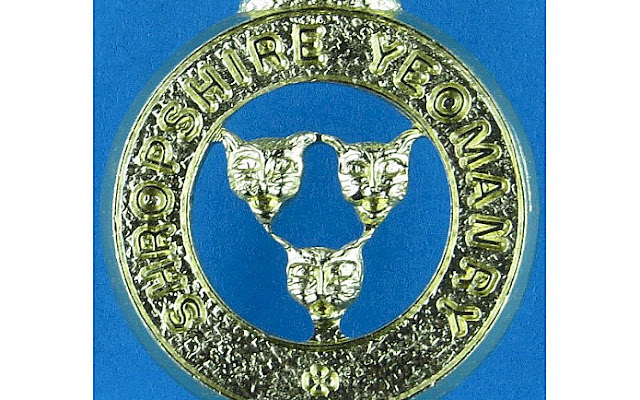
 Shropshire Yeomanry regiment collar badge


A collector of loggerheads pieces is is best off looking at sales of militaria if s/he wants a quick purchase.  The Shropshire Yeomanry regiment didn't always feature the loggerheads in their identification but often enough. Yeomanry collar badges (see pic) are quire common in sales of militaria circles.
Their loggerheads tend to be sharp-eared variety.

Of course, you don't have to buy one to see one.  There are lots of Yeomanry badges at the Shropshire Soldiers Museum at Shrewsbury Castle.

+
To comment on this post, just use the Comments field down this page or email us direct.

To get an email alert into your inbox every time we make a new post (about once a week), just click 'Subscribe & Follow' (at the top of the column to the right on this page) and just fill in the form

Cabbies' shelter

 Former cabmen’s shelter at Shrewsbury Castle
This quaint little structure, just inside the gates of Shrewsbury Castle, is in fact a former cabmen’s shelter/rank. It once stood in the town's Market Square, just a couple of hundred yards away – where it had provided a place out of the rain for cabbies as far back as horse-drawn times.

The roundel in the top window shows the arms of Shrewsbury & Atcham Borough Council, which existed from 1974 to 2009. As the shelter is much older than 1974, one wonders why this badge was installed...
Also... does anyone know exactly how old the shelter is?

+
To comment on this post, just use the Comments field down this page or email us direct.

To get an email alert into your inbox every time we make a new post (about once a week), just click 'Subscribe & Follow' (at the top of the column to the right on this page) and just fill in the form

HMS Shropshire and Atcham

 HMS Shropshire plaque

This plaque, now on display in Shrewsbury Castle Military Museum, was a gift from The Admiralty to Atcham Rural Council in 1943.  Atcham is a village in Shropshire not far from Shrewsbury.
The council was one of those to ‘adopt’ a ship during the Second World War: adoption meant a number of things, from knitting socks for the sailors to financial aid.  Curiously, it must have been very soon after this presentation (perhaps?) that HMS Shropshire was gifted to the Royal Australian Navy, as it was in late 1943.

Interestingly, this is another example of a single loggerhead; and another instance of the tongue being depicted in a 'disc', not lolling, shape. The shape - presumably - is a protruding tongue which is then folded over.  Is that right? Does anyone know the true interpretation?

+
To comment on this post, just use the Comments field down this page or email us direct.

To get an email alert into your inbox every time we make a new post (about once a week), just click 'Subscribe & Follow' (at the top of the column to the right on this page) and just fill in the form

Popular posts